
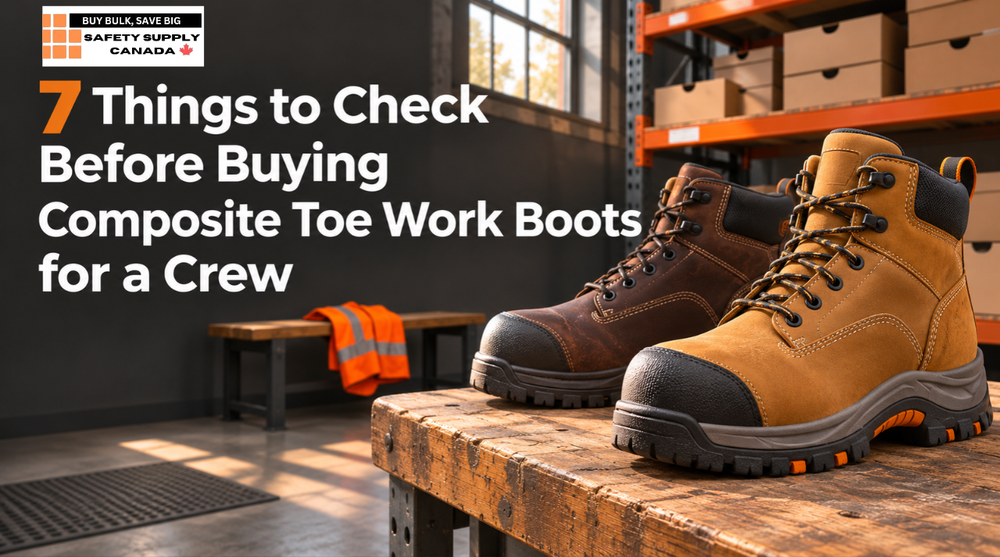
Composite Toe Work Boots for a Crew: 7 Things to Check
Posted by Safety Supply Canada on 16th Nov 2026
KEYPOINTS:
- Choose work boots by matching toe protection with the real hazards employees face during normal tasks.
- Check electrical resistance carefully when crews work around utilities, electrical systems, or industrial maintenance areas.
- Consider waterproofing, insulation, and material performance when workers regularly face cold, mud, rain, or wet ground.
- Review fit, width, cushioning, ankle support, and flexibility before selecting footwear for long daily shifts.
- Compare outsole grip and tread design with the actual surfaces employees walk across during their workday.
- Collect accurate crew sizing information before placing larger footwear orders to avoid unnecessary returns and mismatched stock.
- Plan replacement quantities carefully so businesses maintain enough backup footwear without over ordering rarely used sizes.
- Compare protection, comfort, environment, traction, sizing, and order volume before finalising footwear for an entire crew.
Choosing composite toe work boots for an entire crew requires more thought than picking a familiar style and ordering several pairs. Buyers should check the hazards workers face, the protection required for their tasks, electrical exposure, working conditions, fit, outsole performance, size availability, and how replacement footwear will be managed. A boot that feels suitable in a dry warehouse may not make sense on a muddy construction site or during long outdoor shifts in cold weather.
For businesses ordering for several employees, small differences become important. One uncomfortable design can affect an entire team, while the wrong protection level may leave footwear unsuitable for the work being performed. Before committing to a larger order, purchasing teams should look at seven practical areas: toe protection, electrical risks, environment, comfort, traction, sizing, and purchasing quantity. That creates a more useful starting point for selecting footwear that workers can realistically wear throughout demanding shifts.
Check Required Toe Protection
The first check should always be the hazard the footwear is expected to address. Composite toe caps are designed to provide protective toe coverage without relying on a traditional steel toe cap. However, buyers should not assume that every composite design offers identical features.
Start by reviewing the tasks workers perform. Employees moving heavy materials in a warehouse may face dropped objects, while construction crews may work around timber, tools, concrete products, or equipment throughout the day. Those environments can place very different demands on footwear.
When reviewing protective work footwear, consider:
- The objects or materials employees routinely handle
- Whether puncture risks are present underfoot
- How often workers kneel, climb, bend, or carry loads
- Whether additional plate or midsole protection is required
- The workplace standards relevant to the job
Some composite footwear combines toe protection with non-metallic midsole protection. Others add protective bumpers, reinforced areas, or waterproof construction. For example, a crew installing equipment inside commercial buildings may value lighter footwear and freedom of movement, while workers handling heavy materials outdoors may place more emphasis on rugged construction and sole durability.
The protection should therefore be selected around the actual task rather than the words "composite toe" alone.
Consider Electrical Exposure Carefully
The second check concerns electrical hazards. Some occupations involve regular work around electrical equipment, utilities, maintenance areas, construction systems, or locations where electrical exposure needs additional consideration. In those situations, buyers may specifically investigate electrical hazard work boots.
However, the presence of a composite toe does not automatically mean every boot provides the same level or type of electrical protection. Product specifications and applicable ratings need to be checked carefully.
A purchasing manager selecting boots for electricians, utility workers, or maintenance crews should look at the complete footwear specification rather than concentrating only on the toe material.
Questions worth asking include:
- Does the footwear carry an electrical resistance rating?
- Does the job require metal-free footwear?
- Are there other components in the boot that affect suitability?
- What workplace requirements apply to the crew's tasks?
This matters because some work boots are specifically designed with metal-free construction, while other safety footwear may contain steel components elsewhere in the design. Electrical protection should never be assumed based on appearance. It needs to be confirmed against the actual product information and the conditions in which employees will work.
Match Boots to Conditions
The third check is the working environment. Footwear spends hours in direct contact with the ground, so water, mud, snow, chemicals, oils, uneven surfaces, and temperature can all influence what works well.
For outdoor crews, weather may be one of the biggest factors. A boot suitable for an indoor production facility may become uncomfortable once exposed to standing water, freezing conditions, or soft ground.
This is also where products such as Pioneer rubber boots can enter the purchasing discussion. Rubber or waterproof footwear may be useful for certain wet, muddy, agricultural, maintenance, construction, or outdoor jobs where leather work boots are not always the most practical choice.
Consider a crew dealing with water around an outdoor maintenance project. Keeping composite leather boots as the only footwear option could make little sense if workers regularly stand on wet ground. Their actual environment may call for a different type of waterproof safety boot.
Before purchasing, check:
- Water resistance or waterproof construction
- Temperature suitability
- Resistance to oils or workplace substances
- Mud and debris exposure
- Ease of cleaning
- Flexibility in colder conditions
The right footwear is not simply the boot with the longest feature list. It is the one whose features correspond to the place where the crew actually works.
Does Fit Support Long Shifts?
The fourth check is comfort and fit. This sounds basic, but it becomes much more important when footwear is worn for eight, ten, or even twelve hours. Workers may spend much of that time walking, standing, climbing ladders, carrying materials, or moving between different surfaces. A poor fit can become noticeable quickly.
When reviewing composite toe work boots, purchasing teams should consider more than the numbered size. Toe room, width, ankle support, cushioning, insole design, flexibility, and the socks normally worn on the job can influence comfort.
For example, a worker wearing thicker winter socks may need a different fit from someone using the same footwear indoors. A crew that climbs frequently may also notice boot flexibility more than workers who mainly remain at a fixed workstation.
It helps to consider:
- Available width and size options
- Cushioning around the foot
- Insole construction
- Ankle movement and support
- Boot weight
- Flexibility during walking and kneeling
Comfort should not replace protection, but neither should it be treated as an afterthought. Workers are far more likely to use required footwear consistently when it fits properly and suits the physical demands of their day.
Review Grip and Stability
The fifth check is what happens underneath the boot. Outsole design deserves close attention because employees may work across concrete, gravel, ramps, wet floors, snow, mud, ladders, or uneven ground during a single shift. These surfaces do not create the same traction requirements.
Slip resistance can be especially important in food processing, maintenance, outdoor construction, agriculture, and industrial environments where liquids, mud, or debris may reach walking surfaces. Some safety footwear uses aggressive tread patterns intended to improve traction in snow or mud, while other designs concentrate more on indoor slip resistance. Certain rubber and polyurethane boots are also designed to resist specific workplace substances.
Think about a crew moving between an outdoor yard and an indoor warehouse throughout winter. Their footwear may encounter packed snow outside, wet entrance areas, and smooth industrial flooring minutes apart.
That makes tread design and stability more than a minor product detail. Buyers should examine where employees spend most of their time and which surfaces cause the greatest concern. Choosing a sole for the real environment gives the footwear a practical purpose beyond simply meeting basic protective requirements.
Plan Sizes and Bulk Orders
The sixth and seventh checks belong together: size planning and purchasing quantity. Ordering bulk safety footwear can make sense for organizations supplying several workers, standardizing crew equipment, opening new locations, or maintaining replacement stock. Safety Supply Canada's current footwear range includes products sold in case lots, including composite toe boots and rubber safety footwear.
Still, bulk purchasing needs some preparation. Avoid assuming that a crew of twelve simply requires twelve identical pairs. Workers will have different foot sizes, and certain jobs may require different footwear altogether.
A practical ordering process might include:
- Record each employee's current footwear size.
- Confirm whether wider or unusual sizes are needed.
- Separate workers according to their job conditions.
- Check available sizes before finalizing quantities.
- Estimate likely replacement requirements.
- Keep only a sensible level of backup stock.
A new construction crew, for example, might contain indoor tradespeople, outdoor equipment operators, and workers regularly exposed to wet ground. Ordering one boot style for everyone may look efficient on paper but could create unnecessary compromises.
For larger organizations, maintaining accurate footwear records can also make future replacements easier. Instead of rebuilding the order from scratch, purchasing teams can see which sizes and styles are actually being used.
Make Crew Footwear Count
Selecting footwear for several workers becomes much easier when the decision starts with real job conditions. Toe protection is only the first check. Electrical exposure, wet or cold environments, long shifts, traction, individual sizing, and replacement planning all influence whether composite toe work boots are genuinely suitable for a crew. Businesses should also compare footwear by role rather than expecting one design to solve every workplace risk.
A thoughtful purchasing process can reduce unsuitable orders and make bulk safety footwear easier to organize as teams grow or working conditions change. It also gives purchasing managers a clearer reason for selecting one boot type over another.
At Safety Supply Canada, our team supports businesses looking for safety footwear in commercial quantities across different workplace environments. We focus on helping buyers access practical footwear options for crews while making it easier to compare products, sizes, workplace applications, and case quantities before placing larger orders.
Frequently Asked Questions
Question: Are composite toe work boots lighter than steel toe boots?
Answer: They can be lighter depending on the materials and overall boot construction. Buyers should compare the complete weight and design rather than judging footwear solely by the toe cap material.
Question: Can composite toe footwear be used in wet workplaces?
Answer: Some models can. Buyers should specifically check whether the footwear is waterproof or water resistant and whether its outsole suits wet or slippery working surfaces.
Question: Are all composite toe boots suitable for electrical work?
Answer: No. A composite toe alone does not confirm electrical protection. Buyers should review the footwear's electrical rating and complete construction before selecting it for electrical environments.
Question: How should businesses choose sizes for crew footwear orders?
Answer: Collect individual employee sizes before ordering and account for width, work socks, seasonal use, and available manufacturer sizing instead of estimating sizes across the crew.
Question: When should work boots be replaced?
Answer: Replacement depends on wear, damage, workplace conditions, and product requirements. Footwear should be inspected regularly, particularly when soles, protective components, waterproofing, or structural areas show significant deterioration.


