
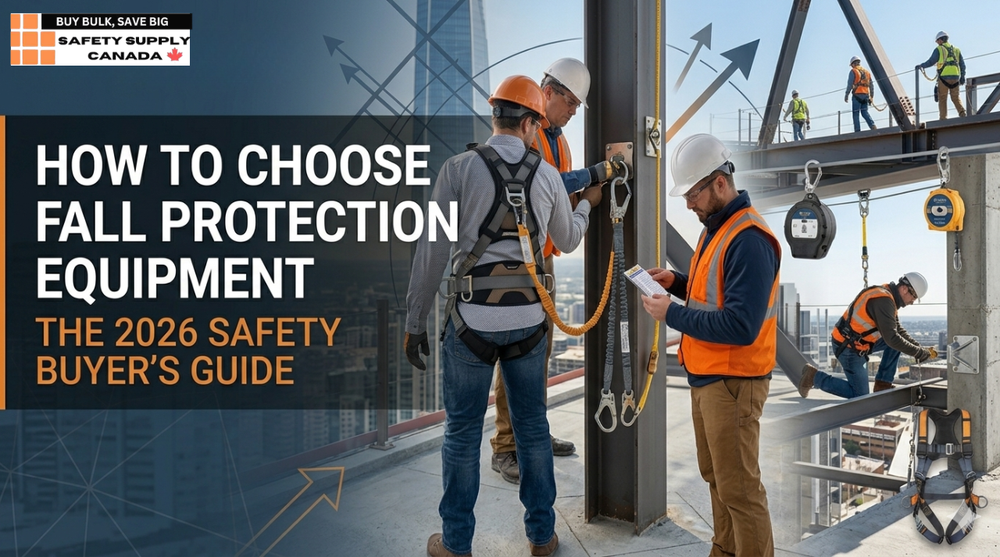
How to Choose Fall Protection Equipment: The Ultimate Safety Buyer’s Guide
Posted by Safety Supply Canada on 9th Apr 2026
Imagine you’re standing on a steel beam, 30 feet above a concrete floor. The wind picks up just a fraction. In that moment, your life isn't in your hands—it’s in the hands of the polyester webbing and steel carabiners strapped to your body.
Every year, falls remain the leading cause of fatalities in the construction industry. The difference between a "close call" and a tragedy usually comes down to one thing: choosing the right gear before you leave the ground.
Choosing fall protection isn't just about grabbing a "bucket kit" and hoping for the best. It’s about matching your equipment to your environment, your height, and your specific job. This guide will walk you through the exact steps to build a system that keeps you safe and compliant.
The Problem: The "False Sense of Security" Trap
Many workers make the mistake of thinking that wearing any harness means they are safe. This is a dangerous misconception. Using a 6-foot shock-absorbing lanyard while working at a 12-foot height is practically the same as wearing nothing at all—you will hit the ground before the lanyard even begins to deploy.
Furthermore, equipment that is uncomfortable or poorly fitted is often worn incorrectly (loose leg straps) or skipped entirely. To stay safe, you need a solution that is technically sound and practical for a 10-hour workday.
The Solution: A Step-by-Step Selection Process
1. Calculate Your Fall Clearance (The Most Important Step)
Before buying gear, you must understand your Total Fall Clearance. This is the minimum vertical distance required between your feet and the lower level to avoid an impact.
To calculate this, you must account for:
- Lanyard Length: Usually 6 feet.
- Deceleration Distance: The stretch of the shock absorber (up to 4 feet).
- Worker Height: Distance from the D-ring to the feet (approx. 6 feet).
- Safety Factor: An extra cushion of space (typically 2-3 feet).
The Math: 6' + 4' + 6' + 3' = 19 feet. If your work area is lower than 19 feet, a standard lanyard won't work. You need a Self-Retracting Lifeline (SRL), which stops a fall within inches.
2. Select a Harness Based on Application
A harness is the foundation of your system. While all must meet ANSI or CSA standards, they vary by task:
- General Construction: Look for a standard 1-point (back D-ring) harness with breathable padding.
- Tower Climbing/Positioning: You need side D-rings on the hips to allow for hands-free work.
- Confined Space: You need shoulder D-rings for vertical retrieval.
3. Match the Material to the Environment
Your gear needs to survive the conditions of your job site:
- High-Heat Work (Welding/Cutting): Choose Kevlar or Nomex webbing that won't melt or burn.
- Electrical Work: Use dielectric harnesses with coated hardware to prevent conductivity.
- Corrosive Environments: For offshore or chemical plants, ensure all metal components are stainless steel or specially coated to prevent rust.
4. Identify a Certified Anchor Point
An anchor is only as strong as what it's attached to. OSHA and provincial safety boards require an anchor point to support 5,000 lbs (22.2 kN) per worker attached. Whether you use a reusable roof anchor, a concrete bolt, or an I-beam clamp, ensure it is installed according to the manufacturer’s specifications.
Real-World Scenarios: Which Gear Should You Use?
Scenario A: The Warehouse Maintenance Worker
- Height: 15 feet.
- Environment: Indoor, low clearance.
- Solution: A Class A Personal SRL. Since the fall distance is short, a standard lanyard is useless. The SRL acts like a seatbelt, locking instantly to prevent the worker from hitting the floor or machinery below.
Scenario B: The Steel Erector
- Height: 50+ feet.
- Environment: High-altitude, moving between beams.
- Solution: A Dual-Leg (Y-Style) Lanyard with rebar hooks. This allows for "100% tie-off," meaning the worker stays connected to the structure with one hook while moving the other.
Final Checklist: Before You Clip In
Safety gear has an expiration date. Even if it looks fine, the sun’s UV rays and dirt can degrade the fibers over time.
- Inspection: Check for "Impact Indicators" (sections of webbing designed to rip during a fall). If these are visible, the harness is trash.
- The 5-Year Rule: Most manufacturers recommend replacing soft goods every five years.
- Training: Gear is only effective if you know how to use it. Ensure your team has had a formal fall protection fit-test and training session.
Don’t Leave Safety to Chance
Choosing fall protection is a technical task, but you don't have to do it alone. Getting the right equipment ensures your crew stays productive, compliant, and—most importantly—safe.
Ready to gear up? We provide wholesale fall protection solutions for teams across Canada. Whether you need harnesses, SRLs, or custom kits, our experts are ready to help.
- Call us: 1 855-960-7369
- Email: orderdesk@safetysupplycanada.com
Buy Wholesale Now and protect your most valuable assets: your people.


